
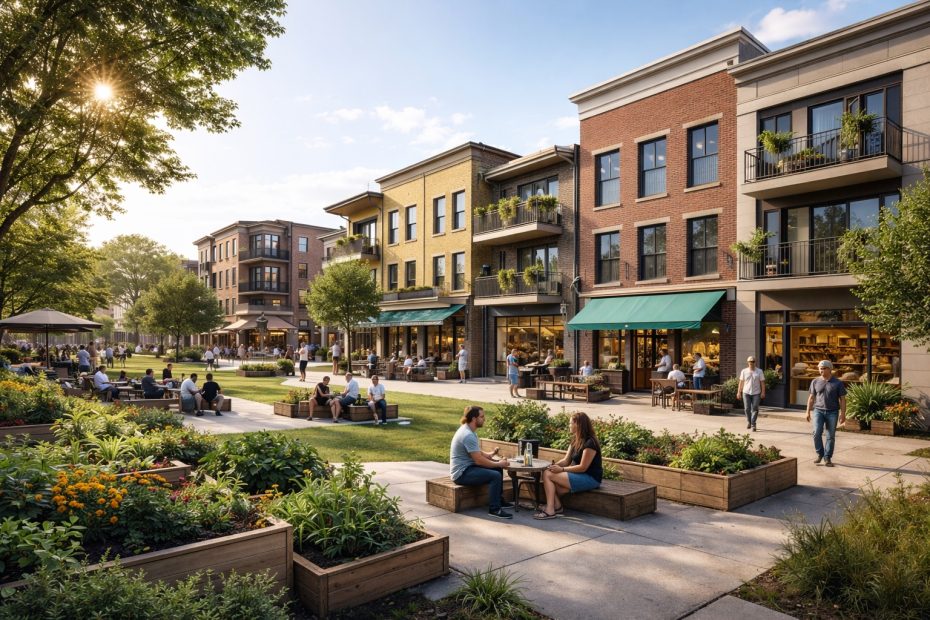
Sustainable community growth means building local ownership, steady financing, strong institutions, and resident control so progress continues after donations slow down. If you want a community to grow for the long run, you need systems that keep wealth, opportunity, housing stability, and decision-making power rooted locally.
That is where this topic becomes practical. You are not looking at charity as a bad thing; you are looking at what comes after it. The goal is to help you identify the models, funding channels, operating choices, and measurement standards that turn short-term support into durable community capacity.
You will see where community wealth building works, why anchor institutions matter, how local businesses and cooperatives strengthen an area, what funding sources move beyond donor dependence, and which mistakes quietly weaken promising efforts. By the end, you should be able to evaluate community growth strategies with a sharper eye and stronger standards.
What Is The Difference Between Charity And Sustainable Community Growth?
Charity addresses urgent need. Sustainable community growth builds the local engine that reduces repeated need over time. When you support food access, emergency rent relief, or basic services, you are solving a real and immediate problem. Yet if the local economy still leaks jobs, land, profits, and contracts outward, the same community often returns to the same crisis point again.
Sustainable growth changes that pattern by focusing on assets and control. You build local businesses, preserve affordable housing, improve access to mission-driven capital, develop resident leadership, and create institutions that continue producing value after outside attention fades. This turns residents from recipients of help into owners, workers, board members, vendors, borrowers, and decision-makers.
The practical shift is from one-time transfer to recurring local circulation. If money enters a neighborhood through grants or donations and leaves just as quickly through outside landlords, external contractors, and absentee-owned firms, the visible activity can still mask weak community power. A stronger model keeps spending, employment, land, procurement, and investment tied to local priorities.
You can think of charity as relief and sustainable growth as local capacity. Relief still matters, especially during stress. Yet if you stop there, you preserve dependency rather than building staying power. A community grows when it controls more of the systems that shape daily life: housing, work, finance, commerce, land use, and civic participation.
This distinction matters for leaders, funders, local governments, nonprofit executives, and business owners alike. If your strategy starts and ends with fundraising, you are managing scarcity. If your strategy builds ownership and recurring value, you are building a stronger local economy.
What Strategies Actually Help Communities Grow Long Term?
The strongest long-term strategies share one trait: they create durable local assets instead of temporary activity. That includes community wealth building, local procurement reform, small-business development, cooperative enterprise, affordable housing preservation, community land trusts, resident-led planning, and place-based capital deployment. These are operating choices, not slogans.
Community wealth building has gained attention because it deals with who owns, who hires, who buys, and who benefits. When hospitals, universities, public agencies, and major employers buy more from local firms, invest locally, hire locally, and support supplier development, they redirect existing economic power toward community goals. You are no longer relying only on new money. You are redirecting money already flowing through the place.
Housing strategy also sits near the center of durable growth. Communities that lose affordability often lose stability, local entrepreneurship, school continuity, and civic participation. Preserving affordable homes, supporting community land trusts, improving housing security, and keeping long-term affordability intact reduces displacement pressure and gives residents a firmer base to build from.
Local business ecosystems matter just as much. A place with many locally rooted firms usually has stronger civic ties, more supplier relationships, and better economic recirculation than a place dominated by absentee ownership. When your community development plan includes procurement readiness, technical assistance, storefront support, access to small-dollar financing, and cooperative business models, you increase the chance that growth stays nearby.
Resident participation also separates durable work from top-down planning. Communities do not strengthen when residents are invited to comment after core decisions are already locked in. They strengthen when residents help shape governance, budget choices, land use priorities, operating goals, and accountability standards. Sustainable growth depends on design and power moving together.
The best results usually come from layering these strategies rather than choosing only one. A community land trust without capital support will stall. Local business support without procurement access will underperform. Anchor procurement without supplier development will favor only firms already ready to scale. Lasting growth comes from linking land, capital, contracts, institutions, and local leadership into one operating model.
How Can A Community Fund Growth Without Depending Only On Donations?
Communities that grow well over time usually build a mixed capital stack. Donations can help launch work, test new programs, or cover gaps that no market or public program will address. Yet long-term growth needs multiple streams: public funding, earned revenue, mission-driven lending, local investment, institutional procurement, lease income, revolving funds, and structured partnerships with anchor institutions.
Public formula funding remains one of the most practical starting points. The United States Department of Housing and Urban Development continues to allocate major Community Planning and Development funding streams that support housing, infrastructure, homeless assistance, and neighborhood investment. If you are working with a municipality, county, regional authority, or nonprofit partner, these channels can anchor long-range planning instead of one-off campaigns.
Mission-driven finance adds another layer. Community Development Financial Institutions, meaning lenders and financial organizations built to serve underserved places and borrowers, help communities finance small businesses, affordable housing, and local facilities where traditional credit may be limited or misaligned. Recent federal awards for technical assistance show continued support for capacity building in this part of the financing system, which matters because good community projects often fail from weak execution capacity rather than weak local need.
Earned revenue is another major shift away from donor dependence. Community-owned real estate, lease income, service contracts, social enterprise operations, membership models, fee-based training, and revenue-sharing ventures create recurring cash flow. When that income is tied to a mission-owned asset, it stabilizes the organization and reduces vulnerability to sudden funding changes.
Anchor institutions can strengthen funding in a quieter but more powerful way through contracts, investment policy, and long-term purchasing commitments. A hospital or university that commits to local sourcing creates predictable revenue for local firms. A foundation or institutional investor that directs a small share of its investable assets into local housing or small-business financing creates capital that works beyond the grant cycle.
Blended finance works best when every dollar has a job. Grant money can cover predevelopment, technical support, or early risk. Public funds can support infrastructure and affordability. Mission-driven loans can finance expansion. Local investment can fill ownership gaps. Procurement contracts can sustain operating cash flow. When you combine these pieces with discipline, your community is not waiting for rescue. It is financing its own future with more control.
What Role Do Local Businesses And Anchor Institutions Play In Community Wealth Building?
Local businesses and anchor institutions often determine whether community growth becomes visible and durable or remains scattered and fragile. Locally rooted businesses tend to hire nearby, purchase from nearby suppliers, and circulate profits within the region at a higher rate than absentee-owned chains or outside contractors. That pattern supports stronger commercial corridors, steadier local employment, and a broader base for civic investment.
The value of local business is not sentimental. It is operational. When your area has a dense network of independent firms, cooperatives, neighborhood service providers, and supplier-ready enterprises, you create more points where money can stay in motion locally. Wages support local spending, contracts support local payroll, and owners are more likely to reinvest where they live and work.
Anchor institutions expand that effect at scale. Hospitals, colleges, universities, public agencies, utilities, and major nonprofit systems are often rooted in place for the long term. They buy food, cleaning services, construction, information technology, security, maintenance, banking services, and professional support. They employ thousands of people, manage real estate, and hold significant financial assets. When those institutions align procurement, hiring, investment, and land use with community goals, the impact moves far beyond charitable giving.
One of the strongest ideas in the anchor mission movement is simple: ask institutions to change operations, not only philanthropy. A donation is useful, but a contract can support payroll year after year. A sponsorship is visible, but local hiring standards, supplier development, and targeted investment shape actual economic structure. This is where you move from public relations to lasting value creation.
Independent business alliances and local economy advocates have long argued that local spending produces stronger multiplier effects. You do not need inflated claims to see the logic. If procurement flows to local firms with local workers and local suppliers, more of that value remains in the area. If procurement flows outward, the community may gain a service but lose the broader economic benefit.
For leaders building strategy, this means the conversation with anchors should become more specific. Ask where they bank, who manages maintenance, who wins food contracts, who handles construction, which investment managers they use, how they define local vendors, and what barriers prevent smaller firms from competing. Community growth becomes more practical when it enters the everyday operations of institutions that are already spending at scale.
Do Co-Ops And Community Land Trusts Really Work?
Yes, they can work well when they are supported with sound governance, technical assistance, patient capital, and a clear operating model. Cooperatives and community land trusts are often discussed as idealistic alternatives, yet their real strength is practical. They help a community keep control of key assets that would otherwise move into extractive ownership patterns.
A community land trust separates land ownership from the building on it, allowing housing to remain affordable across multiple transfers. That matters if your goal is not just building new units but protecting long-term affordability and resident stability. Research summarized by the Urban Institute points to stronger housing-related outcomes for residents in community land trusts on several measures tied to hardship and stability. That does not mean every trust performs the same way. It means the model has credible evidence behind it.
Worker cooperatives and other cooperative business forms support a different but connected objective: shared ownership of enterprise. When workers have a stake in the business, you create a mechanism for wealth retention, better local rootedness, and a stronger link between labor and ownership. International attention to cooperatives continues to reinforce their role in employment, inclusion, and durable local enterprise.
These models are not self-executing. A community land trust still needs land acquisition strategy, stewardship capacity, financing partnerships, legal support, and a management team that can operate well over time. A cooperative still needs market demand, management systems, training, working capital, and governance rules that balance democracy with execution speed. Poorly supported models can fail, just like poorly managed conventional firms.
The real value appears when these ownership structures are integrated into a larger local system. Community land trusts perform better when public agencies support land transfer, nonprofit partners support stewardship, and lenders understand the model. Cooperatives grow more effectively when procurement pathways exist, technical support is available, and local institutions are willing to buy from them. Ownership structure matters, yet the surrounding ecosystem often determines success.
If you are evaluating whether these tools are worth using, the better question is not whether they solve every problem. The better question is whether they preserve affordability, spread ownership, reduce wealth leakage, and stabilize a place under pressure. On those terms, both cooperatives and community land trusts deserve serious attention.
How Do You Measure Whether Community Development Is Truly Sustainable?
You measure sustainable development by tracking whether local assets, local control, local income, and local resilience are increasing over time. Too many plans stop at output counts: dollars awarded, buildings opened, workshops delivered, or people served. Those numbers matter, but they do not tell you whether the community gained structural strength.
Start with ownership indicators. Measure how much land is locally controlled, how many businesses are locally owned, how many workers hold equity, how much procurement reaches local vendors, and how much institutional investment supports community priorities. If your spending rises but ownership stays external, the growth may look impressive while leaving the community exposed.
Housing metrics deserve close attention. You should track long-term affordability retention, housing stability, eviction pressure, cost burden, resident tenure, and displacement risk. If a community claims success because property values rise but long-time residents are pushed out, the development may be profitable for outside interests while weakening local continuity.
Business and labor indicators matter too. Look at business survival, contract access, supplier diversity within the local area, quality of jobs created, wage standards, advancement pathways, and access to credit. Measure not just how many businesses exist, but whether they are integrated into real local demand. A training program without contracts rarely produces lasting change.
Financial resilience is another major category. Assess how much of the growth model depends on one grant source, one public program, one major donor, or one charismatic leader. A sustainable community system has multiple funding channels, stronger local institutions, and the administrative capacity to manage growth without constant emergency fundraising.
You should also track participation and governance. Resident turnout at meetings is not enough. Measure resident representation on boards, ownership participation, decision authority in planning, budget influence, and transparency around contracts and investments. Sustainable development is not just a spending pattern. It is a power pattern.
Federal Reserve research on local spending effects also reminds you to be careful with broad multiplier claims. Economic spillovers vary by place, industry mix, labor conditions, and the nature of the spending itself. That means your measurement system should be local, disciplined, and tied to real operational data rather than recycled talking points.
What Are Common Mistakes Communities Make When Trying To Grow?
The most common mistake is confusing activity with capacity. A place can host meetings, launch pilot programs, announce funding rounds, and produce strong messaging without changing the local economic structure. If the community still lacks ownership, procurement access, financing tools, and durable institutions, the apparent momentum can fade fast.
Another mistake is relying too much on short-term funding. If every major initiative depends on annual grants, emergency appeals, or political goodwill, leaders spend more time patching budgets than building systems. Communities need catalytic capital, yet they also need recurring revenue, financing channels, and institutional commitments that outlast a single funding cycle.
Many communities also underestimate the power of procurement. Leaders often focus on attracting outside investment or winning donor support while ignoring who buys goods and services every day. Contracts for food, cleaning, construction, maintenance, administration, and logistics can shape local opportunity far more directly than a one-time grant announcement.
Top-down engagement is another weak point. Residents are asked to attend listening sessions, fill out surveys, or react to plans already drafted by consultants and institutions. That may produce polished reports, yet it rarely builds trust or shared ownership. Communities grow when residents help define priorities, influence spending, and participate in governance with real authority.
Capacity gaps can quietly damage good ideas. Public funding, community development finance, affordable housing tools, and institutional partnerships all require compliance, staffing, documentation, and operational discipline. A promising strategy can fail if the local organization does not have enough financial management, legal support, project management, or back-office strength to deliver.
One-size-fits-all planning causes damage as well. Borrowed models often ignore local labor conditions, land markets, political realities, existing institutions, and community history. A place-based strategy should reflect actual conditions on the ground, not a copied formula from a conference deck.
There is also a subtle but costly mistake in treating local ownership as optional. If your plan improves amenities but leaves core assets under outside control, the gains may be fragile. Community growth becomes durable when ownership, affordability, enterprise, and governance are built into the operating structure from the start.
What Should You Prioritize If You Want Community Growth That Lasts?
If you want lasting results, prioritize assets, institutions, and operating rules before branding. Start with land control, housing stability, financing channels, procurement pathways, local business capacity, and resident governance. Those are the levers that determine whether benefits remain in the community or move elsewhere.
Put anchor institutions near the top of your list. They already spend, hire, invest, and own at scale. If you can secure local purchasing commitments, supplier development support, targeted hiring channels, and mission-aligned investment, you create durable demand for local enterprises and local projects. Some anchor mission advocates point out that even a small share of investment portfolios redirected locally can support affordable housing, small-business lending, and community financial institutions. That is a meaningful lever when used with discipline.
Protect affordability early. Once speculative pressure rises, it becomes harder and more expensive to keep residents rooted in place. Community land trusts, mission-driven housing ownership, preservation strategies, and public-private land policies can create a stronger base before displacement accelerates.
Strengthen local capital systems. Community Development Financial Institutions, revolving loan funds, neighborhood investment vehicles, and partnerships with public agencies can expand access to financing for businesses, housing, and community facilities. Federal funding streams and technical assistance awards can support this work, yet the long-term aim should be a stronger local financing ecosystem, not permanent dependence on external rescue.
Build procurement readiness into your local business strategy. Help firms meet insurance standards, quality requirements, bonding needs, invoicing rules, and institutional procurement expectations. A community cannot capture contracts at scale if local firms are left without technical support to compete.
Set measurement rules early and keep them public. Track local ownership, housing retention, contract flow, wage quality, business survival, and resident participation. If you only report dollars spent or ribbon cuttings, you are not measuring real strength. Communities improve faster when they know what they are building and how success will be judged.
One more priority deserves attention: administrative competence. The communities that execute well usually combine vision with strong operations. They manage compliance, reporting, partnerships, and capital deployment without letting bureaucracy crush momentum. Strategy matters, yet execution decides what survives.
What Are The Best Sustainable Strategies For Community Growth?
- Build local ownership through cooperatives, community land trusts, and independent businesses
- Redirect anchor institution purchasing, hiring, and investment into local priorities
- Use mixed funding: public programs, earned revenue, mission-driven lending, local investment
- Protect affordable housing and reduce displacement
- Measure ownership, stability, contract flow, and resident decision-making power
Build The Systems That Keep Value Local
Community growth becomes durable when you stop treating donations as the main engine and start building ownership, procurement power, housing stability, mission-driven finance, and resident authority into everyday operations. Charity can relieve pressure, yet lasting progress depends on institutions and assets that continue working after temporary support ends. If you want stronger local economies, look closely at who owns land, who wins contracts, where anchor institutions invest, and whether residents gain real control over the direction of growth. The strongest communities do not just attract resources; they retain and circulate them. That is the shift that turns help into durability and development into lasting local strength.
References
- Organisation for Economic Co-operation and Development: Community Wealth Building For A Well-Being Economy
- Center For Community Wealth: Anchor Mission Framework
- Urban Institute Housing Matters: Do Community Land Trusts Improve Resident Outcomes?
- United States Department Of Housing And Urban Development: Community Planning And Development Formula Program Allocations
- Community Development Financial Institutions Fund: First Awards For 2025
- Institute For Local Self-Reliance: Independent Business Alliances Build Strong Local Economies
- Local Return: Let Those Local Returns Multiply
- International Labour Organization: International Year Of Cooperatives 2025
- The Democracy Collaborative: Community Wealth Building
- Organisation For Economic Co-Operation And Development: Local Development
- Federal Reserve Bank Of Richmond: Impacts Of Government Spending Changes On Local Economies
- United States Department Of Agriculture: ReConnect Loan And Grant Program

Barry Bekkedam is an entrepreneur and finance executive focused on investment management and advisory. A former Villanova standout and member of Canada’s men’s national basketball team, he now leads ventures in asset management and philanthropy, including the Barry Bekkedam Foundation supporting education and community development.