
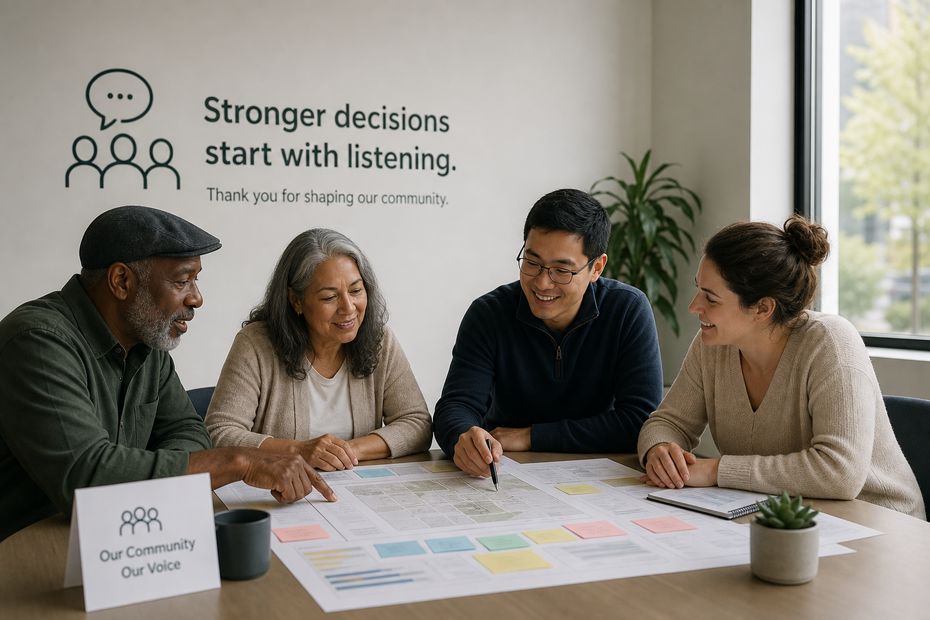
You rebuild community engagement trust after consultation fatigue by making smaller, honest requests, stating what residents can influence, and showing exactly what changed after they participated. If you can’t demonstrate a connection between public input and action, another survey or town hall will deepen the distrust.
Residents usually aren’t tired of caring about their community. They’re tired of giving time, sharing local knowledge, and answering repeated questions without seeing a result. You need to replace participation for its own sake with an accountable process that respects people’s time and tells the truth about decision-making authority.
Why Do Residents Stop Showing Up To Community Meetings?
Residents often stop attending because previous engagement gave them little evidence that participation mattered. What looks like apathy may be a rational response to unanswered surveys, unchanged proposals, repetitive meetings, or decisions that appeared settled before public discussion began.
Attendance alone doesn’t tell you whether people care. Someone may follow a local issue closely yet refuse to spend another evening in a three-hour meeting where a few familiar speakers dominate the microphone. Parents, shift workers, caregivers, younger residents, renters, and people without reliable transportation may care deeply but find the standard public meeting inaccessible.
Repeated absence should prompt an internal review before another outreach campaign begins. Examine what your organization previously asked, what it promised, what changed, and whether residents received an explanation. Review who participated, who didn’t, whose views dominated, and whether your methods rewarded people with the most available time rather than those most affected by the decision.
What Causes Consultation Fatigue?
Consultation fatigue develops when requests for public input outnumber visible decisions, updates, or improvements. People begin to expect that their participation will disappear into a data black hole, so every new request feels like another demand with no credible return.
Repetition is one cause, but poor timing also matters. Several departments may contact the same neighborhood separately, ask overlapping questions, and use different engagement platforms without coordinating their schedules. Residents then receive multiple surveys and invitations from one institution that appears unable to remember what it has already asked.
Complexity makes the problem worse. Technical documents, unexplained planning terms, dense presentations, and long questionnaires shift the burden of interpretation onto residents. If people need specialist knowledge to understand the options, you haven’t prepared them to participate on fair terms. Plain-language summaries, translated materials, visual explanations, and clear decision criteria reduce that burden.
Consultation fatigue differs from basic survey fatigue. Survey fatigue concerns the length, frequency, or design of questionnaires. Consultation fatigue reflects a wider loss of confidence in the entire participation process, including meetings, workshops, digital platforms, committees, interviews, and follow-up. Fixing it requires institutional behavior change, not a shorter questionnaire alone.
How Do You Rebuild Community Engagement Trust?
You rebuild trust by starting with accountability rather than another invitation. Acknowledge what residents previously contributed, identify where follow-up failed, and state what you’ll do differently during the new round of engagement.
That acknowledgment should be specific. Avoid a vague statement claiming that communication could have been better. Tell residents which results were delayed, which commitments weren’t completed, where decisions changed, and why certain requests couldn’t be implemented. Honest limits usually create more confidence than reassuring language unsupported by action.
You also need an accessible record of prior engagement. Publish previous questions, participation summaries, key themes, decisions, outstanding tasks, and responsible departments in one place. Residents shouldn’t have to search meeting archives, disconnected websites, and lengthy reports to discover what happened. A simple engagement history shows that the institution retains community knowledge instead of repeatedly starting from zero.
Trust returns through evidence accumulated over time. One apology won’t repair years of poor follow-up, but several small commitments delivered on schedule can change expectations. Choose early actions that residents can see, document their status, and explain any delays before people need to ask.
How Do You Clarify What Residents Can Influence?
Before requesting input, define what is open to influence, what has already been decided, and what legal, financial, technical, or operational limits apply. Residents should know whether they’re helping set priorities, compare options, improve a proposal, choose an implementation method, or comment on a decision that another body will make.
Treat that explanation as a participation promise. State the decision, the decision-maker, the available options, the constraints, the engagement period, and the date or stage when participants will hear back. If only part of a project remains negotiable, name that part directly rather than presenting the whole project as open.
Use the International Association for Public Participation (IAP2) Spectrum to define the promised level of public influence. Informing, consulting, involving, collaborating, and empowering create different expectations. Problems arise when your language promises collaboration but your process offers a survey with no shared decision-making authority.
Some decisions allow limited public control. Budget limits, safety requirements, contractual obligations, site conditions, or existing approvals may narrow the available choices. You can still run a credible process if you disclose those limits before participation begins. Concealing them until residents propose an unavailable option makes the engagement feel staged.
How Do You Match The Engagement Method To The Decision?
Match the time and effort you request from residents to the importance, complexity, and reversibility of the decision. A minor service adjustment doesn’t need a large public forum, and a major long-term investment shouldn’t be reduced to a quick online poll.
Use brief methods for focused questions. Short Message Service (SMS) polling, intercept conversations, pop-up events, interactive maps, and short questionnaires can help you collect location-specific preferences or identify immediate priorities. These formats work best when the options are understandable and participants don’t need lengthy discussion before answering.
Use deeper methods when trade-offs require learning and deliberation. Small facilitated groups, community workshops, representative panels, co-design sessions, participatory budgeting, and Citizens’ Assemblies give people time to review information, hear competing needs, and revise their views. Research from the Organisation for Economic Co-operation and Development (OECD) supports representative deliberative processes as a way to strengthen confidence in how public decisions are made.
A hybrid participation plan reduces access barriers. Combine digital tools with paper materials, telephone options, staffed drop-in sessions, neighborhood events, and small meetings held in familiar locations. Digital-only engagement can exclude older adults, low-income households, rural residents with poor broadband access, and anyone who struggles with the selected platform.
What Works Better Than Sending Another Survey?
When residents have already answered repeated questionnaires, convene them around a defined choice rather than asking for another list of opinions. Deliberative dialogue lets participants examine trade-offs, ask questions, hear from people with different needs, and develop recommendations that acknowledge real constraints.
Smaller groups often produce a more balanced discussion than open-microphone meetings. Large forums can reward confidence, free time, familiarity with government procedures, and comfort with public speaking. Structured facilitation, timed participation, small-group work, multilingual support, and several ways to contribute can reduce domination by the same recurring voices.
Representative sampling can help you reach beyond the regular meeting audience. Build a stakeholder map based on who is affected, who faces access barriers, who has participated before, and whose knowledge is missing. Direct invitations, community champions, local organizations, schools, libraries, service providers, and neighborhood gathering places can reach people who ignore broad public notices.
Participation support also affects who can contribute. Childcare, transportation assistance, translated materials, interpretation, accessible venues, flexible scheduling, food, and payment for substantial time commitments can remove practical barriers. The level of support should reflect what you’re asking people to give and how much responsibility they’ll carry.
How Do You Close The Feedback Loop?
Close the feedback loop by publishing what you heard, what changed, what didn’t change, and what happens now. Do this after every meaningful engagement stage, not months later when residents have already concluded that their input was ignored.
A useful follow-up report separates input into clear categories. Show recommendations that were adopted, recommendations that changed part of the plan, requests that remain under review, and proposals that couldn’t be used. Give a reason for every rejected or delayed recommendation without hiding behind technical language.
A “You Said, We Did” format can make the connection visible. Pair each major community theme with the related decision, action, responsible team, current status, and expected milestone. If leaders choose a different direction, explain the trade-off and identify who held the authority to make that choice.
Send the update through the same channels used to collect input. Email survey participants, post paper notices where meetings were promoted, update the engagement platform, brief community partners, and provide a phone option for people who aren’t online. Publishing a report on an unfamiliar webpage doesn’t count as closing the loop if participants never learn that it exists.
How Do You Prevent Community Engagement Burnout?
Prevent burnout by treating engagement as a coordinated public service rather than a series of disconnected campaigns. Maintain a shared participation calendar, reuse verified community knowledge, coordinate questions across departments, and limit how often the same residents are asked to contribute.
Create a record of participation commitments and review it before opening a new project. The record should show active consultations, affected communities, recent surveys, promised updates, unresolved actions, and known access needs. This reduces duplication and helps staff identify where a new request would place an unreasonable burden on residents.
Build relationships between formal consultations. Regular neighborhood conversations, community champion networks, small grants, local partnerships, and open progress updates create contact that isn’t always tied to an immediate request. Residents are more likely to participate when your organization has remained present, answered questions, and delivered smaller commitments between major decisions.
Measure more than attendance totals. Review participant diversity, completion rates, repeated participation, missing groups, response times, commitments delivered, recommendations adopted, and participant understanding of the outcome. A crowded meeting can still be unrepresentative, and a small well-selected group can offer valuable knowledge when its purpose and selection method are transparent.
Set an internal rule that no new engagement begins without a follow-up plan, named owner, delivery schedule, and approved communication channels. If your team lacks the capacity to respond, narrow the request or delay it. Asking for input that you can’t process or acknowledge will cost more trust than postponing the engagement with an honest explanation.
How Do You Fix Community Consultation Fatigue?
- Define the real scope of the decision upfront.
- Reach a representative group of residents.
- Use small-group deliberation for complex choices.
- Publish a “You Said, We Did” report.
- Deliver visible actions quickly.
Make Every Future Request Worth Answering
Consultation fatigue won’t disappear because you improve meeting promotion or buy a new digital platform. You need to prove that participation leads to a visible response, even when public input doesn’t produce the preferred outcome. Define the decision honestly, match the method to the size of the choice, include people outside the usual meeting audience, and close every feedback loop. Strong community engagement trust grows when residents can trace a clear line from their contribution to your explanation, decision, or action. Before asking another question, make sure you’re prepared to show your work.
References
- International Association for Public Participation
- Organisation for Economic Co-operation and Development, Public Governance
- National Coalition for Dialogue & Deliberation
- Social Pinpoint Community Engagement Resources
- Route Fifty
- The Harwood Institute for Public Innovation.

Barry Bekkedam is an entrepreneur and finance executive focused on investment management and advisory. A former Villanova standout and member of Canada’s men’s national basketball team, he now leads ventures in asset management and philanthropy, including the Barry Bekkedam Foundation supporting education and community development.