
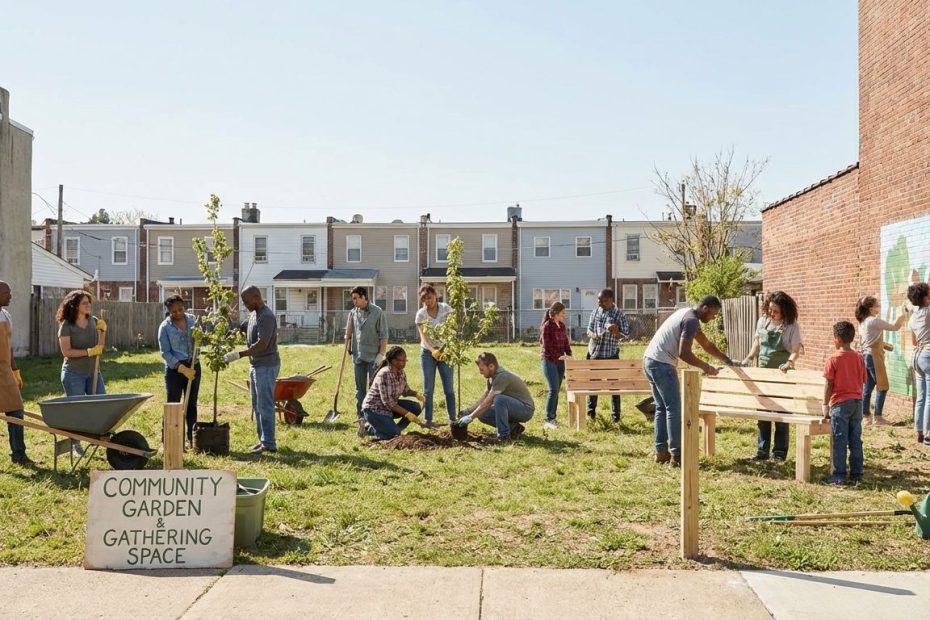
You can turn an empty lot into a useful neighborhood asset when you match the site to local needs, confirm ownership, address safety issues early, and choose a use people will support and maintain. The strongest projects do more than clean up a parcel; they create everyday value through green space, food access, gathering areas, small-scale enterprise, and long-term community stewardship.
If you want vacant land to become a true community hub, you need more than a good idea. You need a clear path from underused property to active public space, with practical decisions around land control, environmental safety, maintenance, funding, and resident trust. This guide walks you through the best uses for empty lots, what makes these efforts work, what usually blocks them, and how you can shape a project that lasts.
What Can You Turn An Empty Lot Into?
An empty lot can become far more than a patch of grass or a temporary fix. In well-run neighborhood revitalization work, vacant parcels often become community gardens, pocket parks, pollinator habitats, outdoor classrooms, play areas, event lawns, food distribution sites, rain gardens, walking paths, market spaces, or mixed-use redevelopment sites. The right answer depends on the lot’s size, ownership status, access to utilities, nearby homes, street visibility, zoning, and whether the community needs a quick activation or a permanent land use change.
You should start by looking at the lot as a piece of neighborhood infrastructure. That means asking what service the parcel could provide that the area already lacks. In one neighborhood, that may be safe play space for children. In another, it may be shade, seating, stormwater management, local food production, or a small flexible venue for weekend events and local vendors.
The strongest reuse plans usually combine more than one purpose. A community garden with benches and a tool shed keeps people on site longer than planting beds alone. A pocket park with trees, open seating, and a small paved area can host daily use and occasional gatherings. A food-focused lot can support raised beds, composting, youth training, and neighborhood distribution without requiring a large capital project.
You also need to decide whether the site should remain open space or move toward full redevelopment. Some parcels are ideal for low-cost greening and long-term stewardship. Others sit in strategic infill locations where housing, live-work units, or civic uses make more sense. Good planning separates land that should stay green from land that should support denser neighborhood investment.
How Do You Turn A Vacant Lot Into A Community Space?
You begin with ownership, not design. Before anyone discusses murals, gardens, trees, or seating, you need to identify who controls the parcel and whether the property is privately held, city owned, tax foreclosed, or part of a land bank inventory. Many lots that look abandoned are already inside a public disposition system, which means your route may run through a land bank, planning department, redevelopment authority, parks department, or code enforcement office.
Once ownership is clear, review zoning and land use restrictions. You need to know whether the parcel can legally support gardening, recreation, vending, structures, stormwater infrastructure, or future building. This is where many neighborhood ideas stall. People move straight into vision boards and volunteer days without checking permits, setbacks, use restrictions, insurance requirements, or whether the city already has a plan for that site.
After that, assess the lot itself. Walk the site. Check access points, slopes, standing water, illegal dumping, visible debris, fencing, sidewalk conditions, street lighting, and how the parcel connects to nearby blocks. A lot with strong visibility and foot traffic may support a gathering space or small market. A lot tucked into a residential block may be better suited for gardening, seating, shade trees, and lower-intensity use.
Your early move should be a low-cost pilot use with a realistic maintenance plan. Clean-and-green treatments, temporary seating, native planting, raised beds, or seasonal programming can test community demand without forcing a permanent buildout too early. That lets you gather support, document use, and refine the project before larger investment enters the picture.
Do Greened Lots Really Improve Safety And Health?
Yes, and this is one of the most useful facts you can bring into a neighborhood revitalization effort. Vacant lot greening has been linked to lower stress, better mental health outcomes, and reductions in some forms of violent crime when the intervention includes cleanup, basic landscaping, visible maintenance, and ongoing stewardship. This matters because empty-lot reuse is often treated as beautification alone, when the evidence points to public health and public safety value as well.
The most influential research in this area comes from studies on restored vacant land in Philadelphia. These studies found that greening neglected lots produced measurable mental health benefits for nearby residents, including lower feelings associated with depression in some settings. Researchers also recorded crime-related effects, with certain interventions linked to reduced gun violence and reduced fear around blighted properties.
You should read these findings in practical terms. A maintained lot changes how a block feels, how often people use the street, how neighbors interact, and how visible a once-neglected site becomes. Regular care signals ownership and attention. Even simple treatments like grass, trees, fencing, and trash removal can shift a parcel from a source of stress to a usable part of the block.
The health benefit also expands beyond research headlines. Cleaner lots reduce dumping, support walking, create cooler spaces with more shade, and offer room for rest, gathering, and local activity. If you are building a case for public or philanthropic support, these outcomes give you a stronger argument than aesthetics alone.
What Are The Best Low-Cost Ideas For Vacant Lot Revitalization?
The best low-cost ideas are the ones that improve daily use without demanding major construction. Clean-and-green treatment remains one of the most effective starting points. That usually includes debris removal, basic grading, grass or groundcover, a few trees, a simple fence, and a maintenance cycle that keeps the site from slipping back into neglect.
Community gardens are another strong option, especially where food access, education, or resident participation matter. If there is any possibility of soil contamination, use raised beds and imported clean soil until environmental review confirms what is safe. Gardening projects work best when you include water access, shade, storage, composting rules, and a named group that handles upkeep.
Pocket parks and mini-plazas offer strong value on small urban parcels. A few benches, trees, permeable paths, and a flexible open area can turn a leftover site into a neighborhood meeting point. These spaces become stronger when they include practical features like lighting, trash receptacles, stormwater planting, and clear sightlines from nearby homes or businesses.
Other low-cost uses include pollinator gardens, native habitat plots, outdoor classrooms, produce distribution sites, public art yards, fitness stations, dog relief areas, and seasonal market spaces. Some neighborhoods benefit from side-lot programs that let adjacent owners maintain and improve parcels that would otherwise sit idle. The main rule is simple: choose a use that the block can support every week, not just during launch month.
Who Pays For Turning Empty Lots Into Community Hubs?
Most successful projects use blended funding. A single grant rarely covers the full path from acquisition to activation to long-term care. You should expect to combine public support, nonprofit involvement, local sponsorship, land bank programs, environmental grants, neighborhood fundraising, and in-kind labor or materials.
If the parcel may be a brownfield, environmental funding can play a central role. The United States Environmental Protection Agency supports brownfields work through programs tied to assessment, cleanup planning, and reuse. That matters when a lot has a former industrial use, dumping history, or unclear conditions that make food production or children’s play areas risky without testing.
Land banks can also be an important funding and control partner. Across the United States, many land banks hold large inventories of vacant lots and already operate side-lot sales, community garden transfers, or neighborhood reuse programs. If a lot is in land bank inventory, the financing discussion may start with acquisition terms and stewardship obligations rather than a traditional real estate purchase.
You should also look at parks departments, stormwater utilities, health systems, local foundations, community development corporations, food policy groups, and place-based business coalitions. A rain garden may attract watershed funding. A play lot may align with public health partners. A market space may draw support from small business or food access programs. Projects gain traction when the funding source matches the public benefit the lot will deliver.
What Problems Stop Vacant Lots From Becoming Neighborhood Assets?
The biggest barrier is usually not creativity. It is control. Many projects fail because no one confirms ownership, no one secures a legal right to use the property, or the land remains vulnerable to sale, redevelopment, or administrative delay. If the community cannot count on access beyond a short term, investment becomes fragile and trust erodes fast.
Environmental uncertainty is another major blocker. Some vacant lots are harmless open parcels. Others carry contamination risk from prior industrial use, demolition debris, fill material, fuel storage, or illegal dumping. If the intended use involves gardening, children, or regular contact with soil, you need proper review before moving ahead. Skipping that step exposes residents and can shut down a project later.
Maintenance is the problem many groups underestimate. A lot looks easy to improve when the focus is on installation day. It becomes much harder when the work shifts to mowing, weeding, trash pickup, water access, repairs, insurance, volunteer coordination, and seasonal cleanup. A parcel without a maintenance owner tends to slide backward, and decline happens faster than most groups expect.
There is also a trust issue. Residents may resist projects led by outside organizations if earlier plans ignored local needs or opened the door to displacement. If a neighborhood has experienced disinvestment, redlining, tax foreclosure, or repeated speculation, people may ask who benefits, who controls the land, and whether the site will still serve local residents after property values rise. Those questions need direct answers early.
How Can You Revitalize Empty Lots Without Triggering Displacement?
You protect neighborhood value by pairing physical improvement with local control. Greening a parcel can raise nearby property values and improve block conditions. That can be positive, yet it can also create pressure if residents gain a cleaner environment without gaining any durable stake in the land, programming, or future development tied to it.
The best guardrail is mission-driven control over the property. That can include land banks with community-centered disposition rules, community development corporations, nonprofit stewards, long-term leases, deed restrictions, affordability requirements, or public agreements that preserve open space or local-serving uses. If a lot is improved with public or philanthropic support, the long-term use should not remain vague.
You should also make resident participation part of governance, not just consultation. A quick survey is not enough. Durable projects usually have a block group, garden committee, neighborhood coalition, or stewardship partner with a defined role in programming and upkeep. When residents help shape hours, uses, maintenance rules, and event priorities, the site is more likely to reflect local needs and hold support over time.
Another useful move is to direct vacant-lot work into anti-displacement goals. That may mean combining greening with affordable housing nearby, reserving market space for local vendors, supporting youth employment, or using land disposition rules that favor community-serving organizations over speculative buyers. Empty-lot revitalization works best when the neighborhood keeps the value it creates.
What Makes Community-Led Vacant Lot Projects More Successful?
Community-led projects succeed because they align daily use with local ownership and real neighborhood demand. Residents know whether a lot needs play space, shade, produce beds, open lawn, better lighting, or a place for small gatherings. They also know what will fail. A design that looks polished on paper can sit empty if it ignores how people move through the block and what they are willing to maintain.
You need a clear stewardship structure before the lot opens. That means naming who unlocks gates, who checks for dumping, who waters plants, who organizes workdays, who communicates with city departments, and who handles repairs. Strong projects are operational, not symbolic. They succeed because someone owns the routine, not because the launch event drew attention.
Programming also matters more than many redevelopment plans admit. A lot becomes a hub when it supports repeated use. That can include produce distribution, youth gardening, senior seating hours, school partnerships, neighborhood cleanups, small vendor days, tree care workshops, or seasonal events. Repetition builds identity. Once the lot becomes part of weekly life, it gains defenders.
You should also respect the difference between activation and permanence. Some neighborhoods need a fast visible win to stop dumping and restore confidence. Others need a long-range redevelopment path tied to housing, public facilities, or commercial reuse. Community-led work performs best when it acknowledges that a temporary intervention can be a useful stage, but not a substitute for lasting land strategy.
How Should You Decide Which Idea Fits A Specific Lot?
Start with five filters: ownership, safety, demand, budget, and operating capacity. If ownership is unclear, you are not ready for design. If safety is unresolved, you are not ready for gardening or play uses. If demand is weak, the lot will struggle to stay active. If budget covers installation but not maintenance, the plan is incomplete. If no one can operate the space, the project will not hold.
Then match the lot to block conditions. A narrow side parcel beside homes may support a side yard, garden expansion, or quiet green space. A corner lot with transit access and street visibility may support a market plaza, seating area, or small mixed-use development. A larger parcel near schools or community institutions may justify a multipurpose design with gardens, event space, stormwater features, and youth programming.
Site history should shape your answer. Brownfield concerns push you toward capped surfaces, raised beds, phytoremediation planning, or non-contact uses until assessment is complete. Repeated dumping may call for fencing, visibility improvements, lighting, and regular maintenance. Flood-prone ground may work better as a rain garden or native planting area than a lawn that demands constant repair.
Your final screen is durability. Ask a plain question: will this lot still function well in three years with the people, money, and systems available? That question filters out many ideas that sound exciting but cannot survive ordinary neighborhood conditions. The best vacant-lot reuse plans are useful on a normal Tuesday, not just during ribbon cuttings.
What Real-World Models Can You Learn From?
Philadelphia’s LandCare model remains one of the clearest examples of how simple vacant-lot treatment can generate measurable public benefit. The model focused on cleaning, greening, and maintaining blighted parcels at relatively low cost. What makes it important is not just the design itself, but the proof that modest physical improvements can produce broader neighborhood gains when they are consistent and visible.
Land bank programs in places like Detroit and other cities show how public land disposition can support neighborhood-scale reuse. Side-lot sales, garden lot transfers, and community-focused redevelopment channels give residents and local groups a path to secure land that would otherwise remain stuck in limbo. That matters because control is often the missing link between a good idea and a lasting outcome.
Municipal garden programs also offer lessons in structure. Where cities support community gardens, the strongest programs provide more than permission. They create application processes, stewardship standards, access to water, basic technical support, and some level of institutional backing. Without that, even popular gardening projects can remain unstable.
National groups focused on vacant land and neighborhood recovery have also documented many creative reuse types, from pollinator parks to produce hubs to educational agriculture sites. The lesson across these examples is consistent: successful projects fit the parcel, meet a visible need, and give residents a role beyond attendance. A vacant lot becomes a hub when it is used, maintained, and defended by the people around it.
What Is The Best Way To Reuse An Empty Lot?
- Confirm ownership and zoning.
- Check for contamination and dumping risk.
- Choose a use residents want and can maintain.
- Start with low-cost greening or pilot programming.
- Secure long-term stewardship before major investment.
Turn Empty Space Into Lasting Neighborhood Value
If you want an empty lot to become a real community hub, focus on utility, safety, and staying power. The most effective projects begin with ownership clarity, environmental review, and a use that solves an everyday neighborhood need. From there, your job is to build visible care, secure funding that matches the lot’s purpose, and put long-term stewardship in place before momentum fades. When you treat vacant land as neighborhood infrastructure instead of leftover property, you create safer blocks, healthier public space, and stronger local control over what comes next.
References
- Center for Community Progress, Vacant Land Project Examples: https://communityprogress.org/resources/vacant-land/projects/
- United States Environmental Protection Agency, Smart Growth And Infill Brownfields Redevelopment: https://www.epa.gov/smartgrowth/smart-growth-and-infill-brownfields-redevelopment
- Center for Community Progress, National Land Bank Survey Dashboard: https://communityprogress.org/data-stories/national-land-bank-survey-dashboard/
- Center for Community Progress, State Of Land Banking Survey Highlights: https://communityprogress.org/blog/2023-land-bank-survey-highlights/
- United States Environmental Protection Agency, Frequent Questions About Brownfields And Urban Agriculture: https://www.epa.gov/brownfields/frequent-questions-about-brownfields-and-urban-agriculture
- National Center for Biotechnology Information, Effect Of Greening Vacant Land On Mental Health Of Community-Dwelling Adults: https://pmc.ncbi.nlm.nih.gov/articles/PMC6324526/
- National Center for Biotechnology Information, Citywide Cluster Randomized Trial To Restore Blighted Vacant Land And Its Effects On Violence, Crime, And Fear: https://pmc.ncbi.nlm.nih.gov/articles/PMC5866574/
- The Pew Charitable Trusts, Neighborhoods Benefit From Community-Led Efforts To Transform Vacant Lots: https://www.pew.org/en/research-and-analysis/articles/2023/06/06/neighborhoods-benefit-from-community-led-efforts-to-transform-vacant-lots
- University of Pennsylvania Center for High Impact Philanthropy, Combating Neighborhood Blight By Transforming Neglected Lots: https://www.impact.upenn.edu/spotlight-philadelphia-landcare/
- Institute for Housing Studies, Supporting Community-Led Strategies To Revitalize Vacant Land: https://www.housingstudies.org/blog/repurposing-vacant-land-disinvested-communities/
- United States Environmental Protection Agency, Local Leadership Makes A Difference: https://www.epa.gov/brownfields/local-leadership-makes-difference-local-officials-guide-brownfields-redevelopment
- Penn Institute for Urban Research, Shane Jensen On The Price Effects Of Greening Vacant Lots: https://penniur.upenn.edu/publications/shane-jensen-on-the-price-effects-of-greening-vacant-lots
- Groundwork USA, Creative Land Use Strategies For Community Benefit: https://groundworkusa.org/creative-land-use-strategies-for-community-benefit/
- City of Columbus, Ohio, Community Gardens: https://www.columbus.gov/Community/Department-of-Neighborhoods/Community-Gardens

Barry Bekkedam is an entrepreneur and finance executive focused on investment management and advisory. A former Villanova standout and member of Canada’s men’s national basketball team, he now leads ventures in asset management and philanthropy, including the Barry Bekkedam Foundation supporting education and community development.