
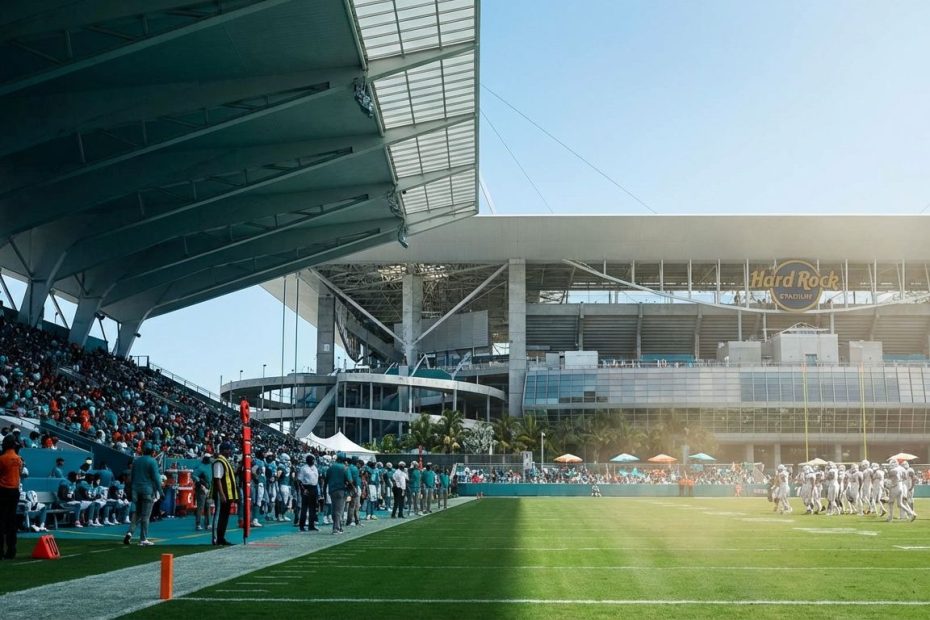
Miami’s “hidden advantage” is real: heat, humidity, and Hard Rock Stadium’s shade pattern can stack the deck by keeping the Dolphins’ sideline cooler while forcing visitors to work in direct sun. When that sun exposure pushes the heat index higher and slows cooling, small performance drops compound into real football outcomes.
You’re going to learn how the stadium’s geometry changes the game, why humidity matters as much as temperature, how jersey color plays into solar load, and what to watch for on broadcast and in box scores when heat stress shows up. If you attend a game, you’ll also know how to pick seats and plan hydration so the “home field heat” doesn’t beat you, too.
Does Miami’s Heat Really Give the Dolphins a Home-Field Advantage?
Yes, and it shows up in two places you can measure: the environment your body has to cool in, and the sideline microclimate where recovery happens between snaps. Miami Gardens brings consistent warmth with persistent moisture in the air, and that moisture changes how fast you can shed heat through sweat.
Heat stress is not just “the thermometer number.” The National Weather Service defines the heat index as the apparent temperature your body feels when air temperature combines with relative humidity, with higher humidity reducing evaporation and making you feel hotter at the same air temperature. When you’re sprinting, decelerating, re-accelerating, then sitting on a bench in the sun, that reduced evaporation matters.
The Dolphins benefit because they’re operating at home in conditions their staff and players build routines around. Visitors can prepare, but they usually don’t live in it, don’t practice in it daily, and don’t carry the same operational muscle memory for managing heat stress across a full game day.
You also get a practical edge: the “recovery window” between series gets longer when your sideline is shaded, your bench surface is cooler, your helmet isn’t baking in direct sunlight, and your trainers can manage cooling more efficiently. The game still happens on the field, but the ability to reset between drives is a quiet separator in September and early fall kickoffs.
Why Is The Visitor Sideline In The Sun At Hard Rock Stadium?
The stadium is built to create a repeatable shade advantage at typical daytime kickoff angles. Hard Rock Stadium’s canopy and orientation are widely described as keeping the Dolphins’ sideline shaded while the visiting sideline stays exposed for much of the game during common afternoon start times.
That design doesn’t change the official weather report, but it changes what players actually experience at shoulder pad level. Direct sun adds radiant heat load on skin, uniforms, benches, and equipment carts. A shaded sideline can feel materially different even when the air temperature is the same, and it can change how quickly players settle their breathing and body temperature after long drives.
Shade guides built for fans also match what shows up on broadcasts and in game photos: you’ll see the home sideline protected sooner, and the visitor sideline taking the sun longer. That consistency matters because football is a repeated-effort sport, and repeated-effort sports punish inefficient recovery.
If you want the simplest “tell,” watch special teams and defensive series late in the second and third quarters. That’s when sideline fatigue starts to show in posture, substitution patterns, and the speed of getting lined up after sudden change.
How Big Can The Temperature Difference Be Between Dolphins And Opponent Sidelines?
On broadcast and in reporting, the sideline gap gets cited around 30°F in some games, with the visitor side reading far hotter than the shaded home side. Those readings are typically local sideline thermometers or spot measurements, not the airport’s official temperature.
That distinction is important because the human body responds to the conditions it’s actually in, not what the weather app reports from miles away. If the visitor bench area is sun-soaked, low-wind, and surrounded by heat-radiating surfaces, that microclimate can climb fast. Add humidity, and the “feel” climbs again because sweat evaporation slows.
A veteran staff plans around this. You’ll see more aggressive cooling rotations, more frequent fluid checks, towels and ice in predictable places, and tighter substitution discipline to keep high-effort players from cooking on the sideline. A team that’s not used to managing those details can look organized early and then start bleeding efficiency later.
When you track this game-to-game, you’ll notice the same pattern: heat stress doesn’t always cause dramatic collapses. It causes small errors, slower reaction, more cramps, more hands-on-knees moments, and less explosiveness in the fourth quarter.
Is Miami Humidity The Bigger Problem Than Temperature?
Humidity is often the multiplier, because it interferes with your best cooling tool: evaporation. The National Weather Service’s explanation is simple: when humidity rises, the evaporation rate drops, and you feel hotter at the same temperature.
That’s why visitors from cooler or drier climates can get surprised even when the air temperature looks “manageable.” You can be in the high 80s and still be in a situation where the heat index pushes your body into a harder thermoregulation fight. In football terms, that shows up as faster fatigue, heavier legs, and more frequent cramping risk as the game grinds.
Miami Gardens climate averages underline the point: it’s not just warm, it’s consistently moist. When humidity and dew point sit high, you don’t get the same cooling relief you’d get in a dry heat environment, and the difference becomes obvious when you’re doing repeated sprints in full gear.
From a preparation standpoint, visitors need to treat a Miami early-season day game less like a normal road game and more like an operational heat event. That means pre-cooling, stricter electrolyte planning, better shade strategy, and a real rotation plan for big bodies on the line.
Do The Dolphins Wear White At Home To Make Opponents Hotter?
Jersey color matters in the sun, and the rules allow the home team to control the decision. Under NFL uniform rules and operations guidance, the home club chooses its jersey color, and the visiting club wears the opposite color based on that selection.
When Miami wears white at home in daytime heat, that choice can push visitors into darker tops, increasing solar absorption when they’re standing in direct sun. The effect is not magic, and it won’t decide a game by itself, but it adds to the total heat load the visitor must manage over four quarters.
Teams also know the psychological effect: you can feel the sun on you, you can see the other sideline shaded, and you can feel your equipment heating up. That’s a real distraction in a sport where focus is currency. You want every ounce of attention on alignment, assignment, and technique, not on surviving the bench.
If you watch closely, the uniform choice pairs with sideline management. White helps, shade helps more, and having both at once creates a consistent advantage in comfort and recovery time.
What’s The Best Modern Example Of Miami’s Heat Affecting An Opponent?
The most cited recent example is Bills at Dolphins, when reports and game coverage described a heat index over 100°F and multiple Buffalo players dealing with heat-related illness. That game became a reference point because the heat impact wasn’t theoretical; it showed up in player availability and sideline behavior.
When you review games like that, focus on practical markers: players leaving to the locker room for fluids, trainers working continuously, substitution patterns tightening, and late-game stamina dipping. Heat stress often hits depth first, meaning backups and special teams units start to feel it before the star players do, and that changes field position, coverage speed, and tackling angles.
It also affects coaching decisions. A staff that feels its defense overheating might slow the game, manage tempo differently, or become more conservative with aggressive calls that keep players on the field longer. That’s not fear; it’s resource management under environmental pressure.
When Miami is on the favorable side of that equation, you’ll see them maintain pace longer, keep defensive pursuit tighter later, and look cleaner in the “messy” part of the game when fatigue usually creates penalties and missed assignments.
If You’re Attending A Dolphins Game, Which Side Of The Stadium Is Shade?
If you’re buying tickets for a daytime kickoff, you need to treat shade as a performance requirement, not a nice-to-have. Multiple shade and seating guides point to the south, home side as the better target for shade coverage, with the north, visitor side getting more direct sun.
That matters for comfort, but it also matters for safety and stamina as a fan. You’re not wearing pads, but you’re also not getting medical staff, cooling towels, and controlled hydration breaks. If you sit in the sun, you absorb radiant heat for hours, and the cumulative load can ruin the experience fast.
Plan like a pro operation: hydrate early, use sunscreen, wear breathable clothing, and know where shaded concourses and cooling breaks are located. If you’re bringing family, that planning becomes even more important, because kids and older adults can struggle in heat that healthy adults can push through.
The easiest ticketing rule stays consistent: pick the shaded side for day games, and don’t assume an overhang will save you unless you’ve verified the row and angle. Hard Rock’s shade line can be sharp, and a few rows can be the difference between comfort and a miserable afternoon.
Why Do The Dolphins Have A Heat Advantage At Home?
- Shaded home sideline, sun-exposed visitor sideline
- High humidity raises the heat index and slows sweat cooling
- Home team can choose white jerseys, forcing visitors into darker tops
Turn Heat Into A Game-Day Edge You Can Read And Use
You don’t need conspiracies to explain Miami’s home-field heat edge; you need basic physics and disciplined game-day operations. Shade reduces radiant load, humidity slows evaporation, and the heat index captures how fast conditions can overwhelm recovery between drives. Jersey choice adds a smaller but real layer by influencing solar absorption on a sun-baked sideline. If you’re evaluating matchups, weight early-season day kickoffs differently, watch substitution patterns, and track fourth-quarter efficiency when fatigue usually cashes its check. If you’re attending in person, prioritize shade seating, hydration, sunscreen, and planned cool-down breaks so the environment doesn’t become the main opponent.
References
- The Washington Post — Dolphins shady home-field advantage makes opponents hot
- Timeanddate — Climate & Weather Averages in Miami Gardens, Florida
- Where’s The Shade? — Hard Rock Stadium Shade Guide
- ShadedSeats — Hard Rock Stadium Seats in Sun & Shade
- National Weather Service — Heat Index and Heat Safety Basics
- NFL Football Operations — NFL Rulebook (Uniform Color Choice)
- NFL Football Operations — Uniform Inspections and Jersey Declarations
- NBC Sports ProFootballTalk — Heat taking its toll in Bills-Dolphins game

Barry Bekkedam is an entrepreneur and finance executive focused on investment management and advisory. A former Villanova standout and member of Canada’s men’s national basketball team, he now leads ventures in asset management and philanthropy, including the Barry Bekkedam Foundation supporting education and community development.