
Buying new golf clubs will not fix your swing because ball flight, consistency, and scoring are driven by how you move the club, not by the club itself. Until swing mechanics, impact control, and decision habits improve, upgraded gear only hides problems instead of solving them.
Many golfers fall into a cycle of buying drivers, irons, and wedges while scores stay the same. This article explains why that cycle persists, what real-world data and coaches consistently observe, and how you redirect money and effort toward changes that actually lower scores.
Should You Buy New Golf Clubs to Improve Your Swing?
New golf clubs rarely improve a flawed swing because they do not change swing path, face control, or strike quality. Those factors come entirely from technique and movement.
Modern clubs are engineered to be forgiving, which can reduce the severity of poor contact. That forgiveness helps keep shots playable, yet dispersion patterns often remain unchanged. You may miss by a few yards less, but the miss still exists.
Golfers often mistake short-term confidence for improvement. A few solid strikes with new clubs create optimism, but once habits resurface, the same misses return.
Do New Golf Clubs Actually Make You a Better Golfer?
New clubs can improve performance only after your swing delivers the club consistently. Without that consistency, equipment changes produce minimal scoring benefit.
Launch, spin, and feel can shift with different shafts or heads. Those adjustments matter when impact conditions repeat reliably. When impact varies widely, equipment influence gets drowned out by swing variability.
This explains why many golfers report no handicap change after upgrades. The swing stayed the same, so results followed suit.
Is It Better to Take Lessons or Buy New Equipment?
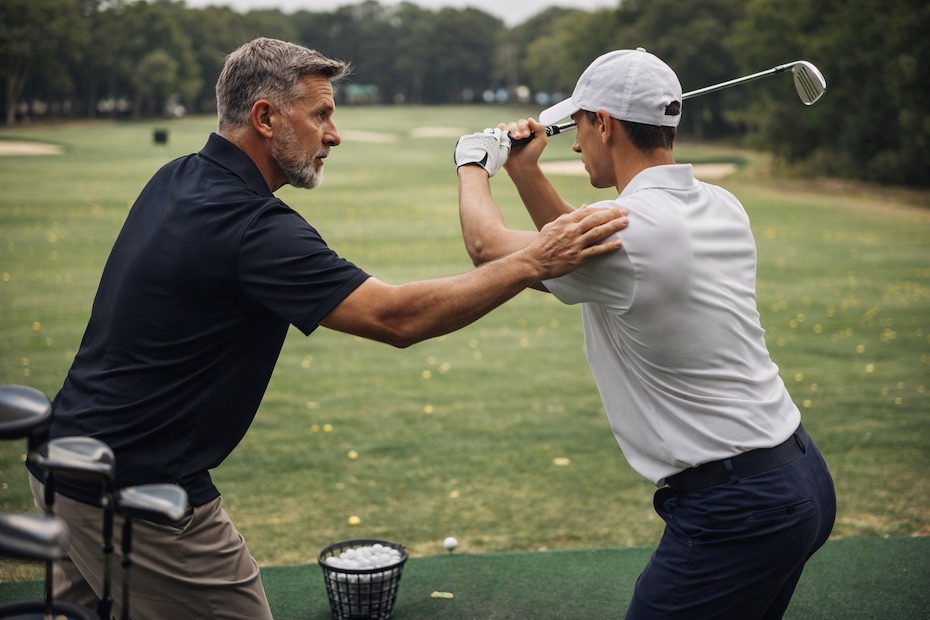
Lessons outperform equipment purchases for most golfers, especially mid- and high-handicap players. Instruction targets root causes rather than symptoms.
A lesson improves setup, sequencing, and awareness. These changes influence every club in the bag. Equipment upgrades affect only one tool at a time.
Coaches consistently observe that a few targeted lessons often produce faster improvement than a full bag replacement. Skills compound, while gear does not.
What Really Causes Inconsistent Golf Shots?
Inconsistency comes from unstable fundamentals. Grip pressure changes, alignment drifts, posture varies, and tempo speeds up under pressure.
Small setup errors magnify during the swing. A slightly open stance alters path. A rushed transition changes face angle. Misses appear random but follow patterns.
Fixing these fundamentals tightens dispersion quickly. No club change can compensate for unstable movement patterns.
Why Do Golfers Keep Buying New Clubs Instead of Fixing the Swing?
Buying clubs feels easier than changing movement. Equipment promises immediate improvement without discomfort or repetition.
Marketing reinforces this behavior. Distance gains, forgiveness claims, and fitting data suggest hardware is the solution. That message resonates with frustrated players.
Swing improvement requires patience and feedback. Many golfers avoid that process, even though it delivers lasting results.
How Do Professional and Elite Golfers View Equipment?
Elite golfers treat equipment as optimization, not correction. Their swings already produce predictable impact conditions.
They adjust lofts, shafts, and weighting only after mechanics stabilize. Equipment fine-tunes ball flight rather than compensating for flaws.
Recreational golfers often reverse this sequence. Equipment changes happen first, limiting benefit and creating dependency.
When Does New Equipment Actually Help Performance?
New equipment helps when swing delivery stays consistent and physical needs change. Shaft flex, lie angle, and grip size matter once impact stabilizes.
Golfers returning from injury or major strength changes may benefit sooner. Those cases remain exceptions rather than the norm.
The right time to buy clubs is after your swing settles. Fit clubs to the swing you own, not the swing you hope to develop.
How Does Focusing on Gear Slow Skill Development?
Gear focus shifts attention away from movement quality. Practice time becomes testing time rather than training time.
Golfers chase distance instead of accuracy. That emphasis encourages overswinging, poor tempo, and loss of control.
Skill development accelerates when focus stays on mechanics, rhythm, and decision-making. Those elements improve every club simultaneously.
What Swing Fundamentals Matter More Than Any Club Upgrade?
Impact control drives ball flight. Face angle, path, and strike location determine start direction, curvature, and distance.
Tempo and sequencing govern those variables. A smooth transition improves center contact and face stability.
Grip, posture, and alignment support consistency. These fundamentals cost nothing yet deliver the largest gains.
How Does Practicing With Your Current Clubs Improve Faster?
Practicing with existing clubs removes distraction. Attention stays on movement rather than equipment feel.
Simple drills sharpen awareness. Half swings, slow-motion reps, and impact feedback improve control quickly.
Progress accelerates when practice targets specific faults. Random ball hitting reinforces habits without change.
Is Club Fitting Worth It If Your Swing Is Inconsistent?
Club fitting offers limited value when swing delivery varies widely. Fit results change as mechanics change.
Many fitters effectively give lessons because technique influences fitting outcomes. This reinforces the idea that swing comes first.
A fitting makes sense once patterns stabilize. At that stage, equipment adjustments enhance consistency rather than chase it.
How Can You Spend Money More Wisely to Improve at Golf?
Invest in instruction focused on movement patterns and impact control. A few lessons often outperform multiple club purchases.
Use simple feedback tools that reveal strike quality and face control. Awareness speeds improvement.
Commit time consistently. Short, focused sessions beat occasional marathon practices.
Will New Golf Clubs Fix Your Swing?
- Equipment does not correct swing mechanics
- Impact control drives ball flight
- Lessons improve scores faster than gear
- Fit clubs after mechanics stabilize
Build a Swing That Makes Any Club Work
If new clubs fixed swings, improvement would be automatic. Real progress comes from stable fundamentals, controlled impact, and disciplined practice. When you stop chasing gear, focus returns to movement quality. Dispersion tightens, confidence grows, and scoring improves. Use equipment as support, not a crutch. Build a swing that performs regardless of what sits in your bag.

Barry Bekkedam is an entrepreneur and finance executive focused on investment management and advisory. A former Villanova standout and member of Canada’s men’s national basketball team, he now leads ventures in asset management and philanthropy, including the Barry Bekkedam Foundation supporting education and community development.