
Today’s young players often look “skilled” because they train what gets rewarded, handles, tough shots, highlight finishes, yet they spend less time on footwork, spacing, passing decisions, and defensive habits that win real possessions. When the game speeds up, those missing habits show up as turnovers, bad angles, missed box-outs, late help, and low-quality shots.
This article gives you a coach-level explanation for why fundamentals keep slipping, what’s actually being missed at different ages, and what to change right now in practices, workouts, and parent expectations so your players improve by the end of the season. You’ll leave with clear practice priorities, simple standards to measure, and a weekly plan that builds fundamentals without draining confidence.
Why Do Today’s Young Players “Look Skilled” But Still Lack Fundamentals In Games?
You’re watching players who train “execution without problems.” In workouts, a cone does not close out, a dummy defender does not recover, and a scripted combo does not force a second read. That training can sharpen touch and coordination, yet it does not build the habits you need when five defenders are connected and the clock is short.
Fundamentals are not a separate category from “skill.” Fundamentals are the repeatable behaviors that hold up when you’re tired, guarded, rushed, or down late. Footwork on catches, balance on stops, pass selection, pivot discipline, spacing that keeps driving lanes open, shot selection that protects team possessions, these are fundamentals. If the training menu is weighted toward isolations and difficult finishes, you end up with players who can create a highlight but cannot manage a possession.
You also see a visibility problem. The loudest feedback in youth hoops often goes to points and “bags,” not to early help, clean box-outs, and the extra pass that creates the advantage. When kids rarely get praised for those winning behaviors, they stop investing in them. A player follows the scoreboard, the stat sheet, and the attention.
Another factor is role confusion. In many environments, everyone is trained like a primary scorer, even if that’s not the role that helps them play meaningful minutes later. If a player is going to be a connector, a defender, a rebounder, a low-mistake decision-maker, that player needs heavy reps in those jobs. When roles aren’t trained, fundamentals collapse under pressure because nobody knows what “a good possession” looks like.
Game speed exposes this fast. A player who can do a clean combo dribble alone still struggles when a defender cuts off the first move, help rotates to the second, and the right play becomes a quick pass to the weak side. That moment is fundamentals: seeing the floor, moving the ball early, relocating with purpose, then defending the next action.
Is AAU Or Travel Ball Actually Hurting Fundamentals, Or Is That Just A Lazy Narrative?
AAU and travel ball are not automatically harmful. You can get better playing strong competition, and exposure is real. The issue you have to manage is the incentive structure: more games, more weekends, more audition-style minutes, and less protected time to teach and repeat the basics until they stick.
When the schedule becomes the identity, practice becomes optional or rushed. Skill development becomes fragmented into private sessions that may not match what your team needs. Team concepts become “learn it on the fly,” and defense becomes “we’ll turn it on later.” That combination produces players who can score in space but struggle with details that don’t show up in highlight clips.
Prominent voices have criticized how these incentives can drift away from teaching. Coach Mike Krzyzewski has been quoted in coverage of AAU discussions pointing to players playing a lot of basketball without enough emphasis on fundamentals and development work away from games. Kevin Garnett has also been quoted blaming AAU for players reaching high levels without being taught the basics and habits that build pride in play.
There’s also a coaching-quality spread. You have excellent AAU programs with real teaching, real practice plans, and role clarity. You also have teams that exist mostly to travel, collect fees, and play, where “coaching” is limited to substitutions and a few set plays. If a player lives in the second type of program, you’re going to see fundamentals erode unless the family, the school coach, or a strong trainer fills the gap.
Travel ball can still work for you if you treat it like competition, not development. Development requires protected hours, consistent standards, and repetition under constraints. If your calendar crowds out that work, fundamentals will slip, no matter how many games you win on weekends.
What Fundamentals Are Coaches Saying Are Missing The Most, And At What Ages?
The missing fundamentals are usually not “shooting form.” They are the behaviors that connect skill to winning possessions: defensive stance and positioning, closeout technique, help-side timing, boxing out, passing angles under pressure, pivot foot discipline, and spacing decisions that make teammates better. When you watch youth games, the breakdowns are predictable: straight-line drives because nobody contains the ball, easy kick-out threes because help is late, turnovers because players don’t pass on time, and constant crowding because off-ball players don’t understand where to stand.
At younger ages, the biggest gap is movement quality. Players struggle to stop under control, change direction with balance, catch and land ready to pass or shoot, and finish off two feet. If those basics aren’t wired early, every “advanced” move becomes a traveling risk and every catch becomes a reset that kills advantage.
In the middle-school window, the gap shifts toward decision-making. Players can dribble and shoot in warmups, yet they don’t know when to attack, when to swing, when to cut, when to screen, when to relocate. They also don’t talk on defense, don’t recognize matchups in transition, and don’t understand how one mistake breaks team defense.
At the high-school age band, the missing fundamental is pace control and role clarity. Many players play one speed, fast. They don’t change gears to read the second defender, they don’t protect the ball late in games, and they don’t value a “good miss,” a shot that keeps your defense set. They also often struggle with physical fundamentals: playing through contact, maintaining stance, finishing possessions with rebounds, then sprinting back with purpose.
If you want the simplest coaching filter by age, use this. Ages 8 to 11: footwork, balance, catching, passing mechanics, two-foot stops, layups on both sides, defensive stance. Ages 12 to 14: advantage reads, pass timing, spacing rules, help and recover defense, basic screening and cutting. Ages 15 and up: role execution, pace, scouting habits, shot selection discipline, strength and conditioning layered on clean mechanics.
Are Kids Practicing Less, Or Just Practicing The Wrong Stuff?
Many kids are not practicing less. They’re often practicing in ways that don’t transfer. A player can put up a lot of shots, but if those shots are unguarded, untracked, and unconnected to game decisions, the improvement is smaller than parents expect. A player can do dribbling routines daily, but if those routines never include reading help defense or passing out on time, turnovers will stay.
Transfer comes from three ingredients: pressure, decisions, and repetition. Pressure means a defender, contact, a timer, a constraint. Decisions means a read, not a script. Repetition means enough volume across weeks that the behavior becomes automatic. Remove any one of those, and you get “looks good in drills” players who disappear when the game gets chaotic.
Unstructured play has also changed. Fewer kids spend hours playing pickup with mixed ages where you learn spacing the hard way, where losing means you sit, where older players punish careless passes. Organized sports are more planned now, and planning is not a problem. The issue is that many organized settings still don’t reproduce the decision density of real play.
Practice design often tells the story. If practice is mostly lines, scripted plays, and long scrimmage time with no constraints, fundamentals don’t improve fast. You’re running a mini-season every day. Players repeat mistakes at full speed, and the loudest player with the most freedom dominates reps. Strong practice replaces long stretches of random play with short, intense blocks that target one habit, then stress-test that habit in small-sided games.
Coaching resources that focus on youth practice planning commonly recommend a large share of time on fundamental skill development, not just scrimmaging. When a practice allocates a meaningful block to ball skills, passing, footwork, shooting habits, defensive technique, then connects those to decision-based small-sided games, players improve in weeks, not months.
How Much Is The Business Of Youth Sports Changing Development: Cost, Private Training, Pay-To-Play?
The business side is changing what families demand and what programs sell. When costs rise, families naturally want proof of return: wins, minutes, exposure, highlights, college talk. That pressure can pull coaches away from development work that looks slow early, even though it pays off later. It also pushes players toward constant competition, where every weekend feels like an evaluation.
Reported family spending numbers help explain the emotion. The Aspen Institute’s Project Play survey reported average spending of $1,016 on a child’s primary sport, up 46% over five years, and also estimated parents spend tens of billions annually on youth sports. When families spend at that level, patience becomes harder. The temptation is to chase quick gains, offensive systems that steal wins today, or private training that promises fast results.
Private training can be valuable when it supports what the player needs. It becomes a problem when it replaces team teaching, or when it is built around marketable moves rather than low-mistake basketball. A trainer sells what a player asks for, and many players ask for scoring. If the trainer does not insist on footwork, passing reads, defensive habits, and decision-making, you get a player who looks polished in workouts and disconnected in games.
Pay-to-play also creates selection pressure. Players feel they must specialize early, play year-round, and travel constantly to “keep up.” That can reduce multi-sport movement benefits and increase overuse issues. It can also narrow the time available for basic work: left-hand finishes, clean pivots, defensive slides, controlled closeouts, two-hand passing on the move.
You can’t coach the entire economy, yet you can coach your standards. When costs and noise rise, fundamentals become a competitive advantage. The teams that defend, rebound, pass on time, and execute late-game possessions beat more talented teams that rely on one-on-one offense.
What Can Coaches And Parents Do This Season To Rebuild Fundamentals Without Killing Confidence?
You rebuild fundamentals by making them unavoidable, measurable, and connected to game action. Players do not need longer speeches. They need repeatable standards and fast feedback in the moments that matter. Confidence grows when a player knows what “good” looks like and can hit that target under pressure.
Start by shrinking the game. Use 1v1, 2v2, 3v3 where every touch forces a decision. Add constraints that force the habit you want: two-dribble max to teach early passing, must hit a paint touch before a jumper to teach rim pressure, must complete a weak-hand finish to teach balance, must communicate on every defensive exchange to teach talk. Small-sided games give you more reps per minute and more teaching moments than full 5v5.
Install a daily defense routine. Five to eight minutes every practice, no excuses. Stance, slide, closeout, high-hand contest, low-hand disrupt, then rebound and sprint. Keep it short, crisp, and consistent. Defense improves when it becomes normal, not a punishment or a special topic for “toughness day.”
Make “boring wins” public. Track box-outs, deflections, paint touches, early help, sprint-backs, extra passes that create the advantage. Put those on the same pedestal as points. When a team sees what earns praise, its culture shifts. Players stop chasing empty highlights and start chasing behaviors that keep them on the floor late in games.
Parents can support this without coaching from the stands. Reinforce standards after games: shot selection, effort on defense, body language after mistakes, whether the player made teammates better. Keep post-game feedback short, specific, and consistent. When a player knows the family values winning habits, the player stops chasing attention and starts chasing growth.
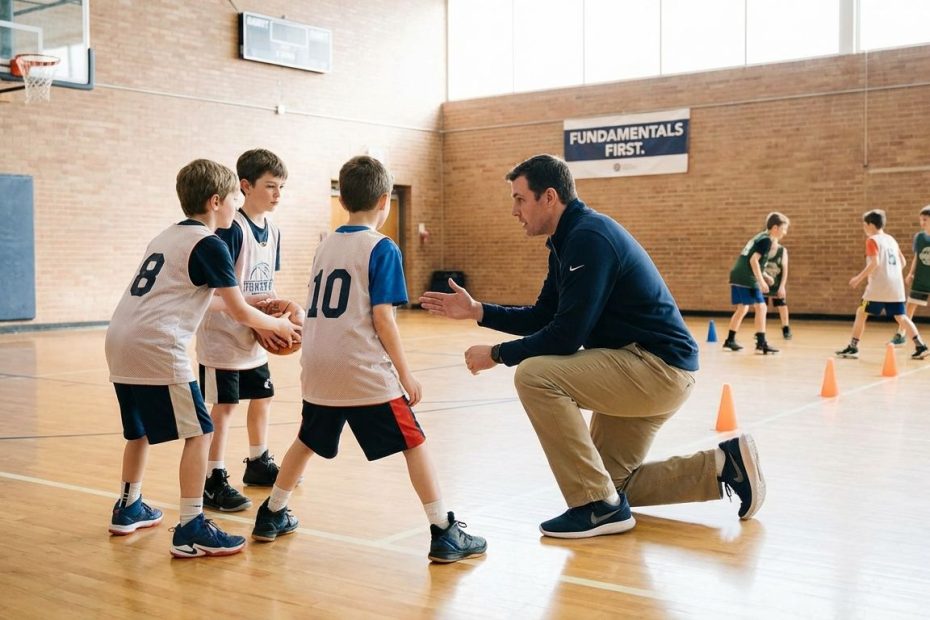
Coaches can also protect confidence by separating correction from identity. Correct the behavior, not the player. Use direct language: “Land on two, pivot strong, chin the ball,” “Close out with choppy steps, high hand,” “Pass on the second defender, then relocate.” Players take correction better when it is a clear instruction they can execute immediately.
Why Do Young Basketball Players Lack Fundamentals?
- Too many games, not enough teaching reps
- Training moves without pressure or reads
- Defense, footwork, passing habits not measured
- Highlight culture rewards tough shots over possessions
Turn Fundamentals Into Your Competitive Edge
You don’t fix fundamentals with one drill or one speech. You fix them by changing what gets trained, what gets measured, and what gets praised every week. When you build practices around pressure, decisions, and repetition, skills start showing up in real possessions, not only in warmups. When you make defense and spacing daily habits, games get simpler and your team plays faster without rushing. Commit to a short list of standards, coach them relentlessly, and watch how quickly players stop “looking skilled” and start playing winning basketball.
References
- Reddit: Are Fundamental Skills Getting Lost In Modern Player Development?
- Coach and Athletic Director: Coach K Shares His Thoughts On AAU
- Yahoo Sports: Kevin Garnett Blames The AAU System
- CBS Sports: Bob Huggins Talks AAU Vs. Playground Hoops
- P.L.A.Y. Basketball Grades 3–8 Coaches Resource Book
- Reddit: Need Help – 1st Game With 9/10 Yr Olds Did Not Go Well
- Project Play: Family Spending On Youth Sports Rises 46% Over Five Years
- Reddit: The Biggest Mistake I See Youth Athletes Make (And How We Correct It)
- Reddit: Change In Defense
- Reddit: Has Travel Ball Ruined My Kid’s Chances After Starting Late?

Barry Bekkedam is an entrepreneur and finance executive focused on investment management and advisory. A former Villanova standout and member of Canada’s men’s national basketball team, he now leads ventures in asset management and philanthropy, including the Barry Bekkedam Foundation supporting education and community development.